Quick answer: Eren Yeager transforms by combining his own blood with physical contact — usually biting his hand — which triggers his inherited Titan power. He primarily wields the Attack Titan, a hardened, immensely fast fighting form passed down through a specific bloodline, and later gains full control of the Founding Titan, the most powerful of the Nine Titans, which lets him influence every “Subject of Ymir” who carries Titan blood.
Table of Contents
How Eren’s Transformation Actually Works
Titan powers in Attack on Titan pass from one human host to the next, usually by a new host consuming the flesh of a dying or defeated Titan shifter. Eren inherits his primary power from his father, Grisha Yeager, who transferred it to him under dramatic circumstances early in the story. From that point on, Eren can transform at will, typically by injuring himself and drawing blood, which acts as the trigger for the transformation.
Once transformed, Eren’s consciousness controls a massive Titan body from within, using a small human-sized core buried at the nape of the neck — the single vulnerable point on every Titan, which is why that specific area matters so much throughout the series’ battles.
The Attack Titan: Eren’s Signature Form
The Attack Titan is the power Eren is most associated with for the majority of the story. It’s traditionally described in-universe as a Titan that “moves toward freedom,” and its most distinctive trait isn’t brute strength but speed, agility, and unpredictable, aggressive combat instincts.
A unique trait tied specifically to the Attack Titan is its ability to access the memories of every previous holder of that power, and — as the story eventually reveals — to receive glimpses of memories from future holders as well, which becomes a major plot mechanism tying past and future events together.
The Founding Titan: Eren’s Most Powerful Form
Later in the story, Eren gains access to the Founding Titan, widely considered the most powerful of the Nine Titans. Unlike the Attack Titan’s combat-focused traits, the Founding Titan’s defining ability is control: whoever holds it and has royal Eldian blood can command every other Subject of Ymir, reshape Titan bodies, and even erase or alter memories on a massive scale.
For most of the story, the Founding Titan’s full power is held back by a self-imposed vow made generations earlier. Eren’s path to unlocking its complete power — and what he chooses to do with it — becomes the central turning point of the series’ final arcs.
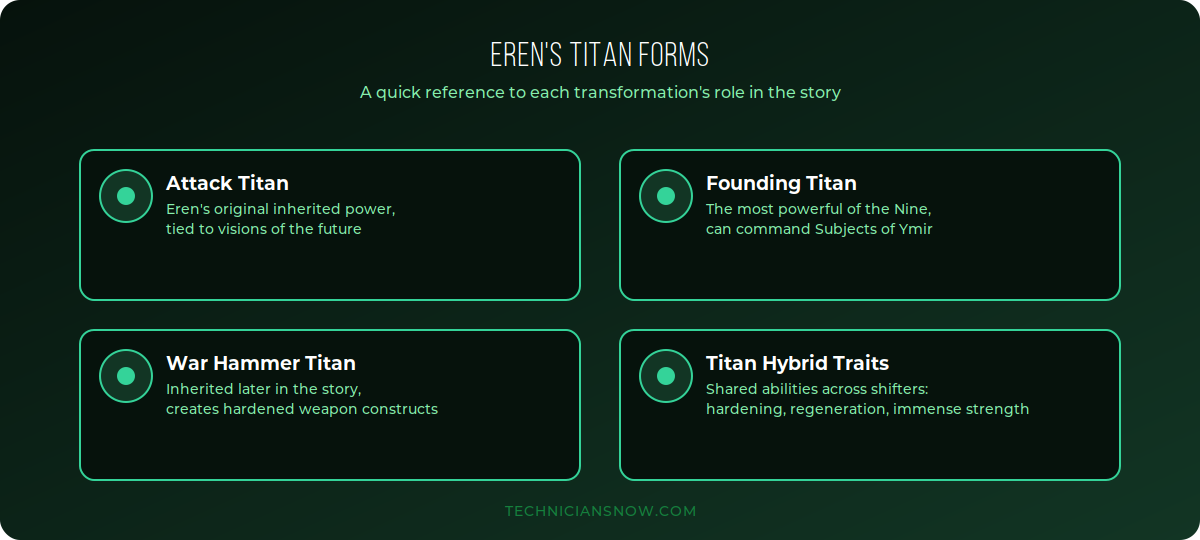
A quick reference to what separates Eren’s two major transformations.
The War Hammer Titan and Later Powers
As the story progresses, Eren also gains access to the War Hammer Titan, a power with a very different skill set from his earlier forms. Rather than relying on raw physical combat, the War Hammer Titan can generate hardened constructs — weapons, structures, and barriers — directly from the user’s body, giving Eren an entirely new tactical option beyond straightforward Titan-on-Titan combat.
Shared Titan Abilities
Regardless of which specific Titan a character controls, a few core traits appear across nearly every shifter in the series:
- Hardening — the ability to turn part or all of a Titan’s body into an extremely durable, crystal-like material, used both offensively and defensively.
- Rapid regeneration — Titan bodies heal from even severe damage remarkably quickly, which is part of why targeting the nape is so consistently emphasized as the only reliable way to stop one.
- Enhanced strength and size — even the “smaller” Titan forms vastly exceed ordinary human physical capability.
Why Eren’s Transformation Matters to the Story
Eren’s transformations aren’t just an action-series power-up — they’re tied directly to the story’s central themes of freedom, inherited trauma, and the cost of power. Each new ability Eren gains raises the stakes of what he’s willing to do to protect the people and the freedom he cares about, and the story deliberately blurs the line between Eren as protagonist and Eren as the figure driving the story’s most devastating events.
The Nine Titans: How Eren’s Powers Fit the Bigger Picture
Attack on Titan’s world features Nine Titans in total, each with a distinct power and its own history of past holders. Eren is unusual in the story specifically because he ends up connected to more than one of these Nine at different points — first through inheritance from his father, and later through the unique properties of the Founding Titan itself. Understanding a few of the other Titans helps clarify what makes Eren’s specific combination so significant:
- The Armored Titan and Colossus Titan — held by other major characters, these are built around defense and sheer size rather than the Attack Titan’s speed-focused combat style.
- The Beast Titan — known for long-range projectile ability and enhanced intelligence retention compared to most other Titan forms.
- The Founding Titan’s uniqueness — unlike every other Titan, which grants its holder a specific combat ability, the Founding Titan grants control over other people, which is what makes it so different in narrative weight from the rest.
Eren’s Transformation vs. Other Titan Shifters
A frequent point of comparison readers look for is how Eren’s abilities stack up against other named Titan shifters in the series. A few consistent patterns hold:
- Eren’s Attack Titan is generally framed around agility and unpredictable combat instinct rather than the largest raw size or defensive durability seen in other Titan forms.
- Once Eren gains full command of the Founding Titan, his practical power ceiling becomes far higher than any single-Titan combat comparison can capture, since it stops being about one body fighting another and becomes about influence over every Subject of Ymir at once.
- Multiple characters across the story explicitly discuss the danger of the Attack Titan and Founding Titan being combined in one person, which is part of why Eren’s specific situation is treated as uniquely dangerous by other factions.
Common Points of Confusion About Eren’s Powers
- “Is the Attack Titan the strongest Titan?” Not in terms of raw combat power — its defining trait is the memory-based ability tied to past and future holders, not brute strength compared to Titans built around size or defense.
- “Can anyone use the Founding Titan’s full power?” No — full, unrestricted command specifically requires royal Eldian bloodline, which is a major plot point tied to how Eren’s path to that power unfolds.
- “Does Eren keep his Titan powers forever?” Titan powers in this series are tied to a specific, well-known time limit after inheritance, which becomes an important pressure point for Eren’s choices later in the story.
If you’re into anime power comparisons like this, our breakdowns of Sukuna, the King of Curses and Zoro’s bounty and abilities cover two other heavily debated cases.
Frequently Asked Questions
How does Eren transform into a Titan? He triggers the transformation through self-inflicted injury, typically biting his own hand, which activates his inherited Titan power.
What is Eren’s strongest Titan form? The Founding Titan, once fully unlocked, is considered the most powerful — it allows control over every Subject of Ymir and the ability to reshape Titan physiology on a massive scale.
Can Eren control multiple Titan powers at once? Over the course of the story he gains access to more than one Titan power, though each has a distinct skill set — the Attack Titan for combat and memory access, the Founding Titan for large-scale control, and the War Hammer Titan for constructed weaponry.
Why does Eren need to bite himself to transform? Blood acts as the physical trigger for a Titan transformation in the series’ internal rules — nearly every shifter is shown using a similar self-inflicted injury to activate their power.
Is Eren’s father, Grisha, also a Titan shifter? Yes — Grisha originally held the Attack Titan (along with the Founding Titan for a time) before transferring the Attack Titan’s power to Eren.