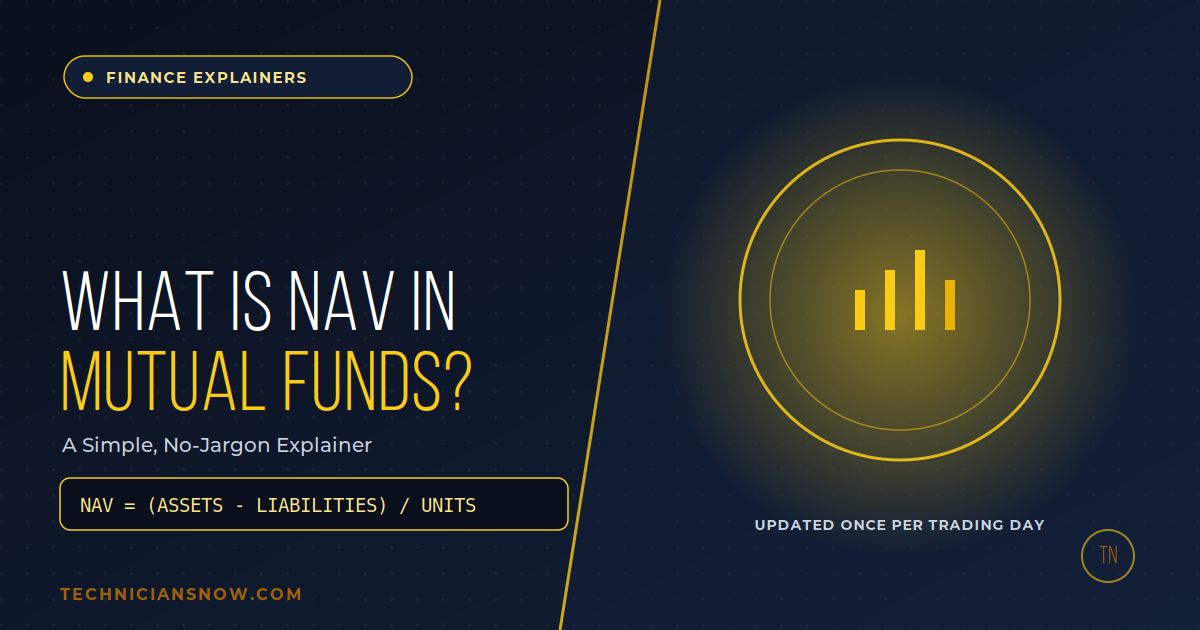
Quick answer: NAV (Net Asset Value) is the per-unit price of a mutual fund, calculated as the fund’s total assets minus its liabilities, divided by the number of units outstanding. It’s recalculated once at the end of every trading day, not in real time like a stock price. A low or high NAV, by itself, says nothing about whether a fund is a good investment — it’s simply a function of the fund’s unit price, not its quality or future performance.
This article is for general education only and isn’t personalized financial advice. Speak with a licensed financial advisor before making investment decisions.
Table of Contents
The NAV Formula
NAV is calculated using a simple formula:
NAV per unit = (Total Assets − Total Liabilities) ÷ Total Units Outstanding
- Total assets — the current market value of everything the fund holds: stocks, bonds, cash, and other securities.
- Total liabilities — the fund’s expenses, fees owed, and any other outstanding obligations.
- Units outstanding — the total number of fund units currently held by all investors combined.
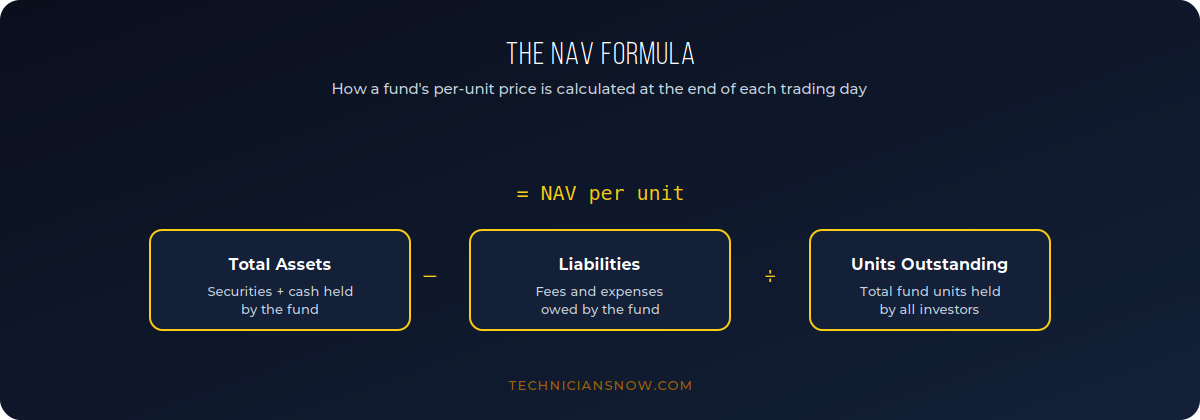
This calculation happens once per trading day, after markets close.
Why NAV Is Calculated Only Once a Day
Unlike a stock, which trades continuously and has a price that changes by the second, mutual funds are priced only once per trading day — typically after markets close, once the fund’s holdings have all been valued at their end-of-day market prices. This is why you can place a mutual fund order during the day, but the actual price you get is always based on that day’s closing NAV, not the price at the moment you placed the order.
Does a Higher or Lower NAV Mean a Better Fund?
This is the single most common misunderstanding about NAV, and it’s worth addressing directly: NAV alone tells you nothing about a fund’s quality or future returns.
Consider two funds that both started at ₹10 per unit five years ago:
- Fund A grew to a NAV of ₹15 — a 50% gain.
- Fund B grew to a NAV of ₹40 — a 300% gain.
Fund B has a much higher NAV, but that’s simply a reflection of its stronger historical growth rate — not a sign that it’s now “more expensive” or a worse deal than Fund A. Similarly, a brand-new fund launching at ₹10 per unit isn’t inherently “cheaper” or a better value than an established fund trading at ₹200 per unit; the number of units you can buy for a given amount of money differs, but the underlying value of your total investment behaves the same way either way.
What actually matters for comparing funds is performance over time (percentage returns), expense ratio, and how the fund’s strategy fits your goals — not the raw NAV number.
How NAV Changes Over Time
A fund’s NAV moves based on the combined market value of everything it holds:
- If the fund’s underlying stocks or bonds rise in value, NAV increases.
- If they fall, NAV decreases.
- Dividends or interest the fund receives, minus its operating expenses, also factor into the daily NAV calculation.
This is different from a fund’s returns, which measure the percentage change in NAV (plus any distributions) over a specific period — returns are what you should actually be comparing across funds, not the raw NAV figure.
Where to Find a Fund’s NAV
- Directly on the asset management company’s (AMC’s) official website
- Through your brokerage or investment platform’s fund page
- Financial data sites and regulatory disclosure portals that publish daily fund NAVs
Always check that the NAV you’re viewing is current as of the most recent trading day’s close, since NAV doesn’t update in real time during market hours.
NAV and SIP Investments
For investors using a Systematic Investment Plan (SIP) — regular fixed contributions rather than a single lump sum — NAV plays out slightly differently in practice:
- Each SIP installment buys units at that specific day’s NAV, not a fixed price across all your installments.
- This means your average purchase price across a SIP naturally varies over time as NAV moves up and down — a concept often called rupee-cost averaging, since you buy more units when NAV is lower and fewer units when NAV is higher, for the same fixed contribution amount.
- Your total investment value at any point is simply your accumulated units multiplied by the current NAV, regardless of what NAV was on each individual purchase date.
NAV, Total Return, and Why Both Numbers Matter
Two related but distinct figures often get confused:
- NAV — the current per-unit price, a snapshot in time.
- Total return — the percentage change in your investment’s value over a period, factoring in both NAV changes and any distributions (dividends or capital gains) paid out along the way.
A fund could show a relatively modest NAV increase over a year while still delivering a strong total return, if it also distributed meaningful dividends during that period — which is why comparing funds purely on NAV movement, without accounting for distributions, can understate a fund’s actual performance.
A Simple Way to Think About NAV
If it helps, think of NAV the way you’d think about the price of a single share of a pizza that’s already been baked and divided into slices: the size of each slice depends on how many slices the pizza was cut into, not on how good the pizza is. A pizza cut into 8 large slices and an identical pizza cut into 16 smaller slices contain the same total pizza — the slice count just changes how big each individual piece looks. NAV works the same way: it reflects how a fund’s total value has been divided into units, not the underlying quality of the fund itself.
NAV and Fund Types: Does It Work the Same Way Everywhere?
The core NAV formula applies across nearly all mutual fund types, but a couple of fund-type-specific details are worth knowing:
- Open-ended funds (the most common type) calculate and publish NAV daily, and you can buy or redeem units at that day’s NAV on any business day.
- Closed-ended funds also have a NAV, but they trade on an exchange like a stock, meaning the actual market price you pay can differ from the fund’s NAV — sometimes trading at a premium or discount to it.
- Exchange-traded funds (ETFs) similarly have a NAV calculated daily, but since they trade throughout the day on an exchange, their market price can briefly diverge from NAV before arbitrage mechanisms bring it back in line.
For a standard open-ended mutual fund — the type most retail investors hold — NAV and the price you actually pay or receive are the same number, which is what makes it the most straightforward case to understand first.
Common NAV Misconceptions, Summarized
- “A ₹10 NAV fund is cheaper to buy than a ₹500 NAV fund.” Not meaningfully — you simply get more units of the lower-NAV fund for the same money, but your total investment value behaves identically either way.
- “NAV going up means I should buy now before it goes higher.” NAV movement reflects past performance already baked into the price; it isn’t a signal about future direction on its own.
- “Two funds with the same NAV are similarly valued investments.” Not necessarily — NAV alone says nothing about the underlying portfolio composition, risk level, or strategy of either fund.
Frequently Asked Questions
Is a mutual fund with a lower NAV a better buy? No — NAV is simply the per-unit price, not an indicator of value or future performance. Compare funds using percentage returns and expense ratios instead.
How often does NAV change? Once per trading day, calculated after markets close using that day’s final asset valuations.
Does NAV include the fund’s fees? Yes — the expense ratio and other fund costs are factored into the daily NAV calculation, meaning the NAV you see already reflects those costs.
Can I buy mutual fund units at a price different from the NAV? Generally no — mutual fund units are bought and sold at that day’s NAV (sometimes with a separate sales charge or load added on top, depending on the fund and platform).
Why did two similar funds have very different starting NAVs? This usually just reflects each fund’s own base unit price set at launch and its performance history since — it isn’t a meaningful comparison point between two different funds.